Right beginnings.
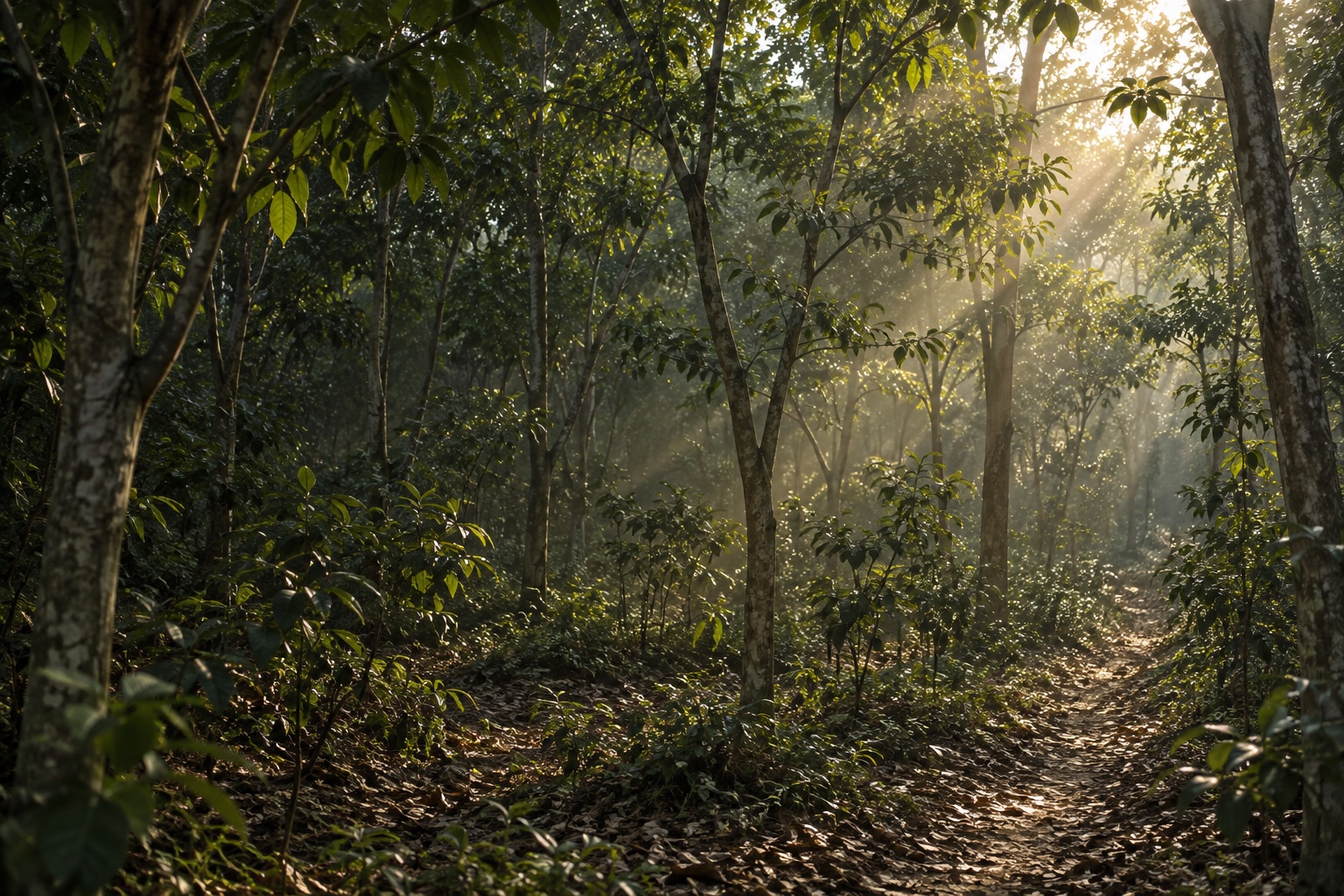
Planting stock, host plants and drainage planned around the site’s growing conditions.
Contract Farming Sandalwood plantations
01 / Managed sandalwood plantations
Heartwood Plantations offers managed White Sandalwood plantations, with a planned 15-year cultivation journey.
Planting, host selection, irrigation, tree care and harvest assessment—brought together in one management approach. We call it Pure Potential: a passion for cultivation, with a long view of the tree and the land.
We manage the plantation. Agricultural land is purchased separately.
Meet the tree at the heart of it allPlanting stock, host plants and drainage planned around the site’s growing conditions.
Agronomic guidance, irrigation and plant-health monitoring through each stage of growth.
A 15-year cultivation programme, from sapling to heartwood assessment.
Beneath the bark / A closer look
02 / The tree
Unassuming on the outside.
Extraordinary within.
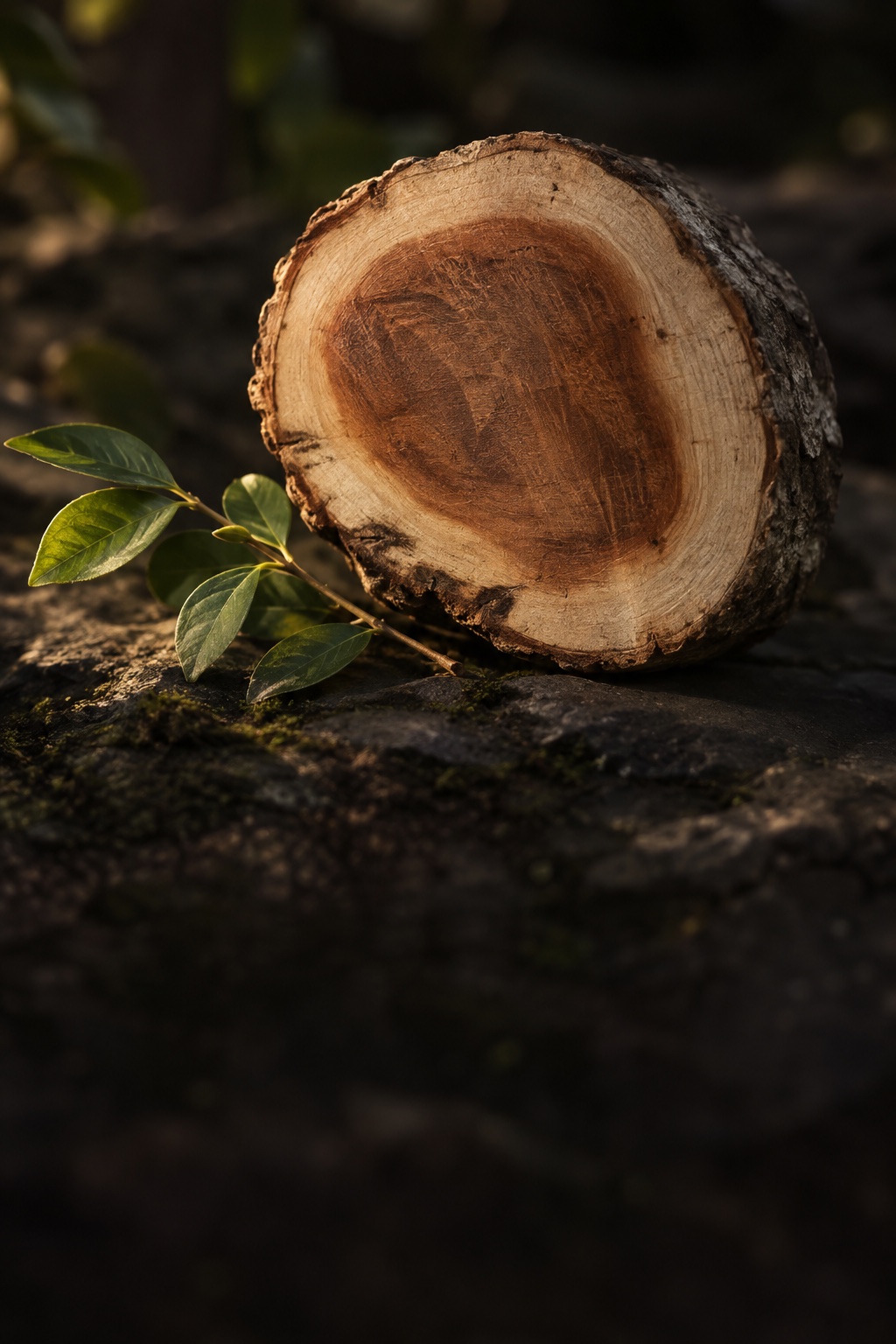
White Sandalwood carries its character in its fragrant heartwood. Slowly, beneath the bark, the tree develops the aromatic wood prized in perfumery, craft and cultural traditions.
The heartwood gives sandalwood its character—and Heartwood its name.

Santalum album is a root hemi-parasite. It draws part of its water and nutrition through host plants. A thoughtful host system is fundamental to the plantation design.
Heartwood development and oil content vary with genetics, growing conditions and tree health. Our planning horizon is 15 years; harvest readiness requires assessment of the actual trees.
Verified planting stock, well-managed hosts, drainage, appropriate irrigation and plant-health monitoring work together. No cultivation method can remove biological or market risk.
The wider perspective / Sandalwood demand
Quality, buyer requirements and lawful trade shape a sandalwood sale. Future demand and prices depend on the market at harvest.
03
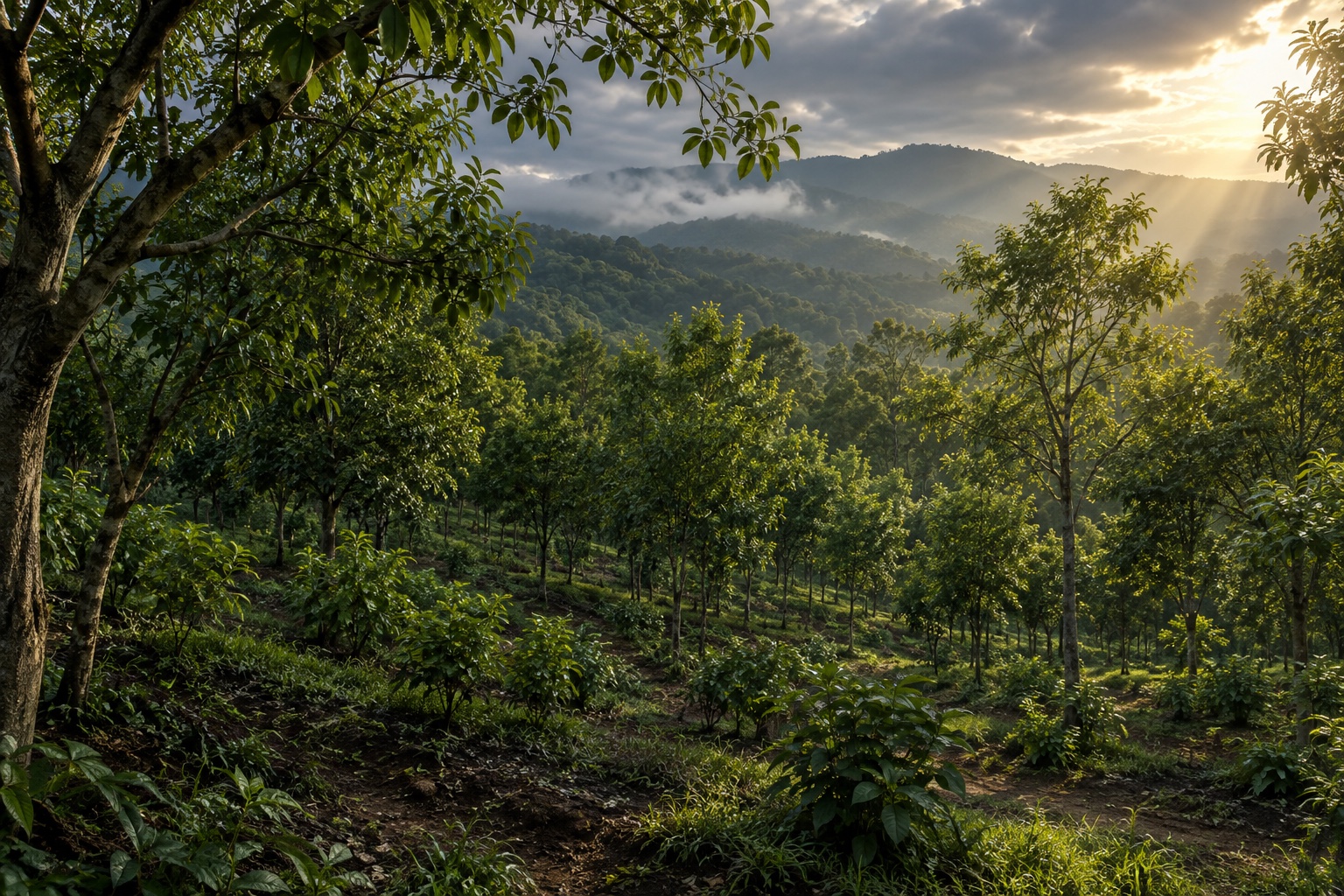
The Konkan region is the perfect setting for our planned White Sandalwood plantation.
AI plantation study · Not a real site photograph.
The approximate estate scale
described in the project brief.
Soil from different sections of the land has been tested for sandalwood feasibility.
The site approach
The project brief records soil testing across different sections of the land to assess sandalwood suitability. In a high-rainfall setting, that potential depends on planned drainage, suitable hosts and dependable water management.
Work with the natural contours. Plan water flow to avoid stagnation. Combine controlled drip irrigation with dry-season contingency planning. Match host selection and ongoing care to local conditions.
*Approximate gross estate area, not confirmed net plantable area or current availability. Plot boundaries and saleable area require survey and documentation.
04 / The 15-year journey
From planting to harvest assessment.
Explore the five stages of the plan.
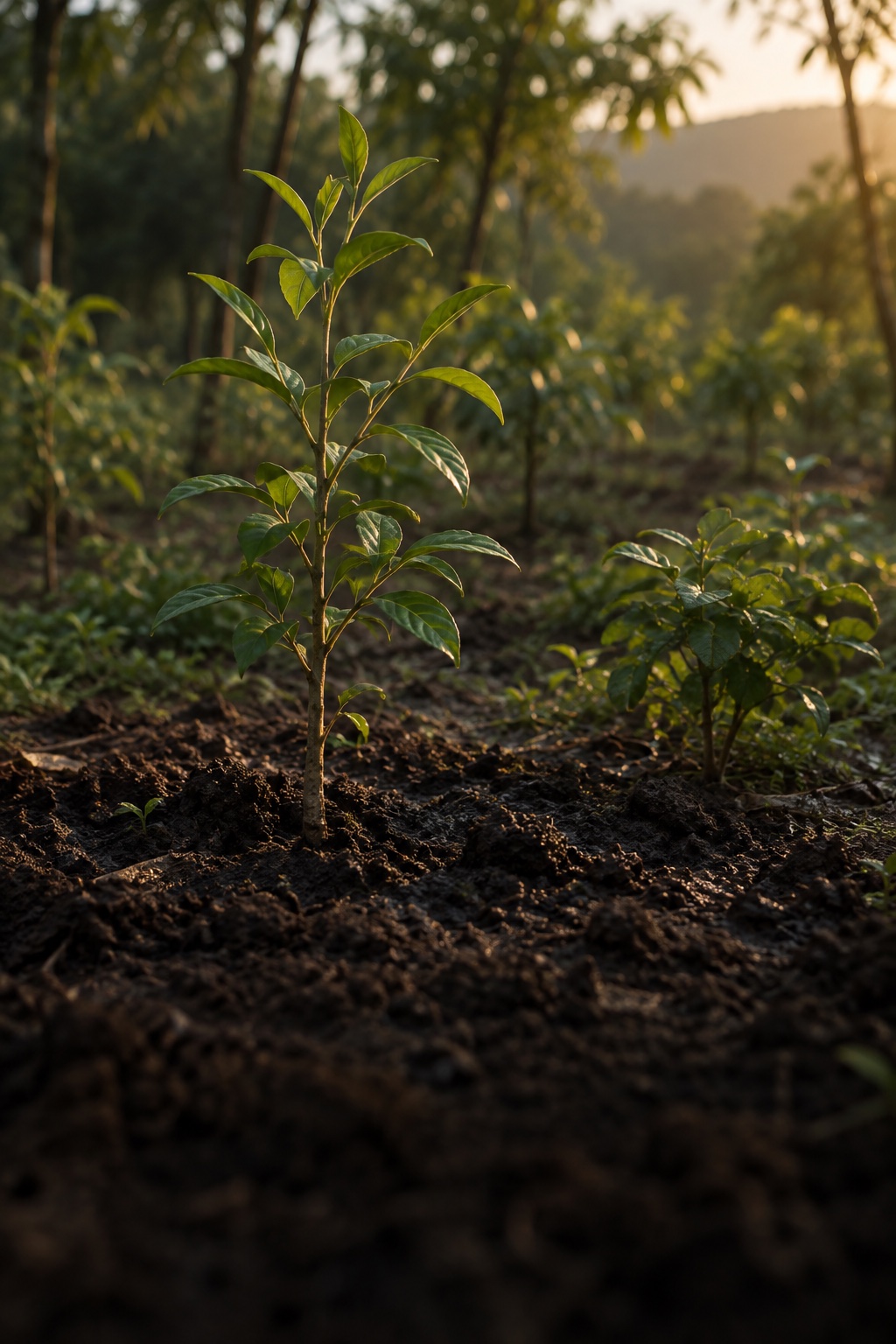
Establish · AI study, not an actual growth record
The first roots / Years 1–2
Prepare drainage and irrigation, verify planting stock and establish sandalwood with its hosts. Early monitoring and timely replacement give the plantation its foundation.
Soil · saplings · host relationships
An indicative management sequence, not a biological guarantee. Harvest timing depends on maturity, permissions and market conditions. The signed agreement governs the 15-year term and any exit rights.
05 / Our methodology
Planting stock, host systems, drainage and ongoing care.
The practical work behind each stage of growth.
Understand soil and natural contours, route drainage and plan seasonal water availability before planting. Monitor conditions as the site develops.
Assess sapling provenance and vigour. Plan sandalwood spacing with room for host roots and light. Final density follows the agreed agronomic layout.
Design temporary and permanent host relationships, guided by site-specific advice. The Konkan agronomic brief identifies Casuarina and Pongamia as proposed permanent hosts.
Use controlled irrigation, seasonal pruning and regular plant-health observation. Adapt inputs to the tree and the conditions, supported by local agronomy and specialist review.
Plan layered security and keep records of the plantation’s development. Assess heartwood and readiness before harvest, with the required permissions and documented sale process.
Agri-tech / Care, made visible
Proposed mapping, monitoring and records,
with agronomists interpreting the results.
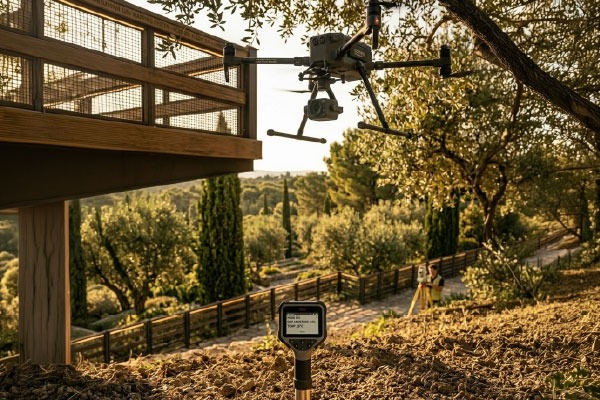
Proposed digital parcel maps and planting registers connect sandalwood, host plants and establishment records to the relevant owner’s land.

Planned soil and water observations, irrigation records and repeat photographic checks help agronomists track conditions across seasons.
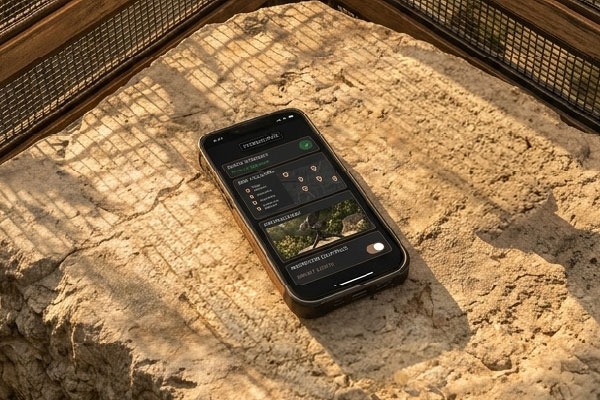
Plant-health logs, survival checks and recorded interventions support timely review of nutrition, pests, disease and replacement needs.
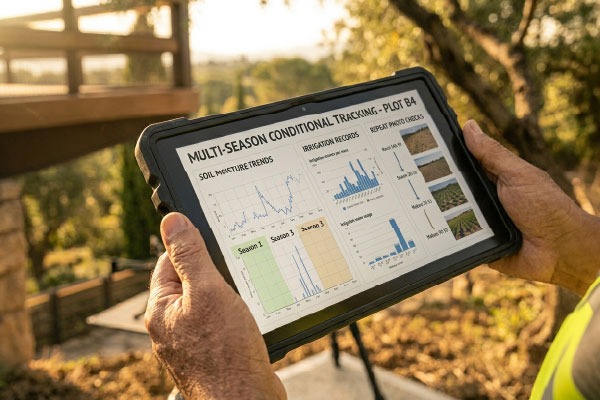
Proposed periodic growth reports, parcel-level inventory and documented harvest and sale records support transparent stewardship.
This is the proposed monitoring approach, not a claim that a sensor network, drone programme or customer dashboard is already deployed. Tools, reporting cadence, access and responsibilities must be confirmed in the management scope.
06 / The advisory panel
International perspective. National experience.
Regional science. Day-to-day care.
01 / Global perspective. Cultivation experience.
With 35+ years in forestry, Grant is Managing Director of GP Forestry (est. 2012) and Chairman of the Australian Sandalwood Network. A former senior forester and business unit manager with Western Australian government forestry agencies, he built deep expertise in Australian and Indian sandalwood. He has worked with leading sandalwood and agarwood plantation businesses and with growers across Asia, the Pacific Islands, Africa and Sri Lanka, and has authored scientific papers on sandalwood.
Expertise: With a strong foundation in silviculture, he brings experience in sandalwood and agarwood systems, plantation design, plantation health management, and natural revegetation.
A National Innovative Farmer Award winner (Ministry of Agriculture, Government of India), Dr. Mishra has also received the Karnataka Rajyotsava Award and the Krishi Jagran Award, and was recognised by Mahindra Group’s Millionaire Farmers of India initiative. Trained in Computer Science Engineering and Psychology, she runs an integrated farming model spanning sandalwood, fruit and agroforestry nurseries, beekeeping, sheep rearing, indigenous poultry and dairy. She is also associated with Karnataka’s veterinary and fisheries university governance and contributes to community-based natural resource management and rural outreach.
Expertise: Her work focuses on sandalwood cultivation, integrated farming, agroforestry, and horticulture, with a strong emphasis on farmer empowerment.
02 / Regional science. Daily stewardship.
A Ph.D. in Forestry from the Forest Research Institute, Dehradun, and Professor at the College of Forestry, Dapoli. Dr. Rane has published 90 research papers, co-authored 8 books and contributed 14 book chapters. He has led 10+ externally funded projects worth about ₹3 crore, developed and commercialised bamboo propagation technologies and superior bamboo clones, and trained over 1,000 farmers in bamboo and medicinal plant cultivation. His work has helped set up bamboo nurseries, agarbatti units and high-curcumin turmeric cultivation.
Expertise: He brings a strong foundation in forest genetics, bamboo cultivation, medicinal and aromatic plants, agroforestry, and nursery development.
An M.Sc. Agriculture Gold Medallist (86.40%) with 20+ years of experience in commercial horticulture, plantations and irrigation. Chief Plantation & Irrigation Consultant at Sindhudurg Plantations since 2006, he has guided projects across roughly 2,500 acres, including a 250-acre bamboo plantation, a 1,500+ acre group farming project, and integrated farms of 200-350 acres with white sandalwood, Alphonso mango and cashew. Former Principal of C. S. College of Agriculture and College of Agri-Business Management, Oros, he has also designed landscapes for 75+ villas and bungalows and consulted on the Sindhudurg Mega Food Park.
Expertise: His professional practice encompasses plantation planning, white sandalwood, mango and cashew cultivation, irrigation management, integrated farming, and vermicomposting.
Credentials and proposed roles reflect the supplied advisory brief. Final appointments, engagement scope and public biographies remain subject to confirmation. Portraits are as supplied by each advisor.
 AI botanical study · illustrative, not site photography
07 / Growing responsibly
Water, soil and host plants are part of the cultivation plan. Here is how we approach each.
Plan drainage and controlled irrigation around seasonal conditions and root health.
Build host relationships, maintain soil health and use inputs with agronomic discipline.
Track cultivation practices and plant health over the management term.
These are stewardship commitments. No quantified carbon removal, carbon credits, carbon-neutral status or biodiversity certification is claimed.
08 / Ownership & stewardship
Three indicative parcel sizes.
Land purchase and plantation management, separately agreed.
These are rough indicative prices. Actual annual maintenance will be charged on a cost-book basis plus a 20% plantation company fee.
Heartwood facilitates introductions for separate agricultural land purchases in the Konkan region but does not sell land. Buyers must independently verify title, eligibility, boundaries, pricing, and registration.
A separate agreement with Heartwood Plantations LLP defines establishment, cultivation, management, costs, the planned 15-year term and harvest sharing. Heartwood is the plantation company; the land purchase and management arrangement are legally distinct.
Parcel sizes are indicative and subject to survey and availability. The executed agreements must establish participation, transfer and early-termination terms. Plantation charges are separate from land costs and may change. No legal entitlement, liquidity, return or tax treatment is promised by this website.
The business model / Your parcel, your trees
Your share comes from the sandalwood on your own land.
Each parcel has its own harvest account.
| Parcel | One-time establishment | Annual maintenance | 15-year service total* |
|---|---|---|---|
| ¼ acre | ₹2 lakh | ₹25,000 | ₹5.75 lakh |
| ½ acre | ₹4 lakh | ₹50,000 | ₹11.5 lakh |
| 1 acre | ₹8 lakh | ₹1,00,000 | ₹23 lakh |
These are rough indicative prices. Actual annual maintenance will be charged on a cost-book basis plus a 20% plantation company fee.
Indicative rates, subject to change. *Setup plus 15 annual payments at unchanged rates; no escalation assumed. Land price, statutory charges, taxes and any additional costs are separate. Obtain the current written quotation and agreed scope.
10 / Questions, answered
Plantation services, costs and contracts.
The questions to start with.
Heartwood Plantations LLP provides plantation establishment, cultivation, and management under a separate agreement. It facilitates introductions for agricultural land purchases but does not sell land. Verify the land transaction independently; Heartwood’s service agreement defines the plantation scope, costs, term and revenue sharing.
It is the intended management horizon in the brief. The executed agreement must define the commitment, start date, early exit, transfer and termination terms. Do not assume a right to withdraw, transfer or terminate outside those agreed terms. Harvest is subject to actual tree maturity and required permissions.
No. Yield, tree survival, heartwood quality, sale prices, land value and timing are uncertain. Any figures shown are illustrations only. Crop loss or inability to realise a sale can reduce harvest proceeds to zero. Land may lose value and may be difficult to sell.
Heartwood’s service fee is 35%, applied through your farming contract after a documented sale and agreed deductions. Each parcel has its own harvest account; revenue from trees on your parcel is not pooled with, or distributed to, owners of other parcels. The signed agreement must confirm the sale process, accounting and any applicable deductions.
Current indicative setup charges are ₹2 lakh for ¼ acre, ₹4 lakh for ½ acre and ₹8 lakh for 1 acre. Annual maintenance is indicatively ₹25,000, ₹50,000 and ₹1,00,000 respectively. These are rough prices: actual maintenance will be charged on a cost-book basis plus a 20% plantation company fee. These rates may change and are separate from land purchase. Inclusions, escalation, taxes and additional charges must be agreed in writing.
Heartwood is a plantation company, not the land company. The end of the plantation-management term does not itself transfer or sell your land. Your rights arise from the separate land purchase and title documents; any continuing plantation obligations follow the management agreement. Future use, conversion, construction or sale remains subject to applicable laws and permissions.
Weather, waterlogging, disease, pests, theft, poor establishment, host performance and uneven heartwood development can affect the crop. Monitoring and management reduce some exposures but cannot eliminate them. No insurance cover is represented unless separately documented in an applicable policy.
Request the current project and cost details, proposed plantation-management agreement and confirmed advisory scope. Separately request and verify the land title, survey records, purchase eligibility, and sale documents from the landowner. Review both arrangements with independent advisers before deciding.
Prepare an enquiry11 / Your next chapter
Enquire about cultivation, management
and the proposed terms.
White Sandalwood. Expert-led cultivation.
A long view of growth.
PURE POTENTIAL.